

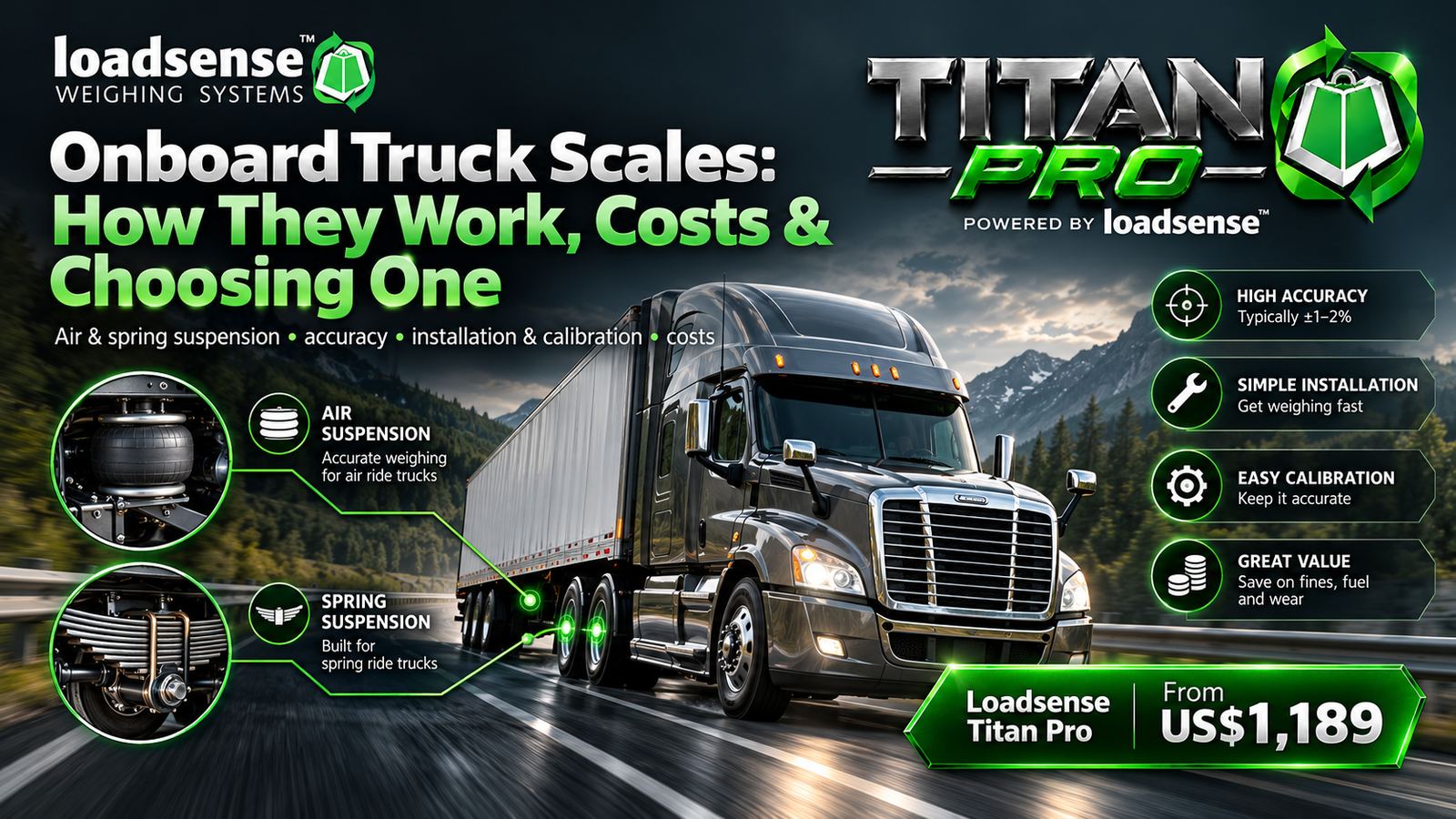
Onboard Truck Scales: How They Work, Costs & Choosing One
An onboard truck scale tells you what your truck and trailer weigh while you load, so you know you’re within your limits before you leave the yard, not when you reach a weighbridge or a roadside check. This guide explains how onboard scales work on different suspension types, how accurate they are, what they cost, and how to choose one.
What is an onboard truck scale?
An onboard scale uses sensors fitted to your truck and trailer to measure the load on each axle group. A central unit turns those readings into weights and shows them to the driver. With the Loadsense Titan Pro, that unit is the Integrator, and the weights appear in the free Loadsense app on your phone.
The main reason fleets fit one is load positioning. A truck can be under its total weight limit and still have one axle group overloaded. With sensors on every axle group across the truck and trailer, you can see exactly where the load sits and move it before it becomes a fine.
How onboard scales weigh, by suspension type
Different suspensions need different sensors. A good system lets you use the right one on each axle group.
- Air suspension: an air sensor reads the pressure in the airbags, which rises as load goes on. Loadsense offers wireless air sensors, which use RF rather than Bluetooth and reach up to 50 m line of sight to the Integrator, and wired air sensors.
- Mechanical spring (leaf spring) suspension: a rotary height sensor measures how far the spring compresses under load, once calibrated. Strain gauges are another option for spring suspension.
- Highest accuracy: loadcells mounted between the chassis and the deck give the most accurate onboard weighing, typically within 0.5 to 1%.
- Tippers and hoists: a hydraulic pressure transducer weighs using the pressure in the hoist ram as the load lifts.
Mixing sensor types on one truck and trailer
Many combinations run air suspension on the truck and springs on the trailer, or the other way round. The Titan Pro Integrator takes up to 8 sensors, and they don’t all have to be the same type. So you can fit an air sensor to the drive axles, a height sensor to a spring trailer, and loadcells where you need the highest accuracy, all on one system and one screen.
In-cab display or phone app?
Most onboard scales use a dedicated in-cab display. Loadsense sends weights by Bluetooth to an app on Android or iOS instead, and two phones can connect at once, so the driver and the loader both see the weights as the load goes on. The app shows:
- A live load gauge that changes colour as you load: green while you’re comfortably within your limit, amber when you’re getting close, and red with OVERLOAD RISK or WEIGHT EXCEEDED warnings.
- Gross and net weights for the whole combination, plus each axle group.
- A landscape dash view with large Total Gross and Total Net readouts. Turn your phone sideways to use it.
The Integrator also stores the calibration for every sensor, so a new or replacement phone can pick it up without recalibrating. Watch the app walkthrough.
How accurate are onboard truck scales?
Accuracy depends mostly on the sensor type:
| Sensor type | Typical accuracy against a weighbridge |
|---|---|
| Air sensors (wireless or wired) | Within 1 to 2% |
| Loadcells | Within 0.5 to 1% |
| Height sensors (mechanical spring) | Within 1 to 3% |
| Strain gauges | Within 1 to 3% |
We say “typically” because some factors affect any onboard scale on the market. For the most accurate reading, weigh when the vehicle is stationary and, where possible, on level ground. If accuracy is your top priority, choose loadcells, which typically weigh within 0.5 to 1%.
What do onboard truck scales cost?
The Loadsense Titan Pro starts from US$1,189, including the Integrator, the app, and one wireless RF or wired air sensor. You add sensors to suit the number of axle groups and suspension types you need to weigh. Installation is not included.
When comparing prices, compare like with like. Some scales in this price range are simple indicators with a single readout. The Titan Pro weighs mixed suspension on one system, uses RF wireless air sensors rather than Bluetooth, takes up to 8 sensors, and runs on your phone with overload warnings and stored calibrations.
Ongoing costs: the app is free. Loadsense also offers an optional real-time cloud reporting tool linked to the scale, at US$1.50 per day, billed annually (US$547.50 a year).
Warranty: the Titan Pro Integrator and sensors come with a 1-year warranty.
Installation and calibration
Installation typically takes 3 to 4 hours, depending on how many sensors are fitted across the axle groups. Anyone with practical mechanical knowledge can install a Titan Pro. Installer rates vary, so ask your local installer or distributor for a quote.
Calibration is done by the driver in the app:
- Weigh the vehicle empty on a weighbridge or CAT Scale, then enter the tare (empty) weight for each axle group in the app.
- Weigh it loaded, then enter the loaded weights.
- The Integrator saves the calibration for each sensor.
Check your calibration against a weighbridge periodically, and recalibrate after engineering work on the truck or trailer, or after adding components that change its tare weight.
Onboard scales, weighbridges and portable scales
A weighbridge or CAT Scale is still the reference point. It’s what you calibrate against, and it gives you a weight for one moment in one place. An onboard scale gives you weights while you’re loading, wherever you are, so you can get the load right the first time instead of driving to a weighbridge and back.
Common mistakes to avoid
- Buying a cheap “dumb indicator” and finding later that it can’t handle mixed suspension or give per-axle-group weights.
- Fitting sensors to only one axle group. You can’t see load positioning, which is where most overloads happen.
- Never re-checking calibration, especially after modifications that change the tare weight.
- Choosing the wrong sensor type. If you need high accuracy, choose loadcells.
Onboard truck scales FAQ
How much does an onboard truck scale cost?
The Loadsense Titan Pro starts from US$1,189, including the Integrator, the app and one wireless RF or wired air sensor. Installation is extra.
How accurate are onboard truck scales?
Loadcells are typically within 0.5 to 1% of a weighbridge. Air sensors are typically within 1 to 2%, and height sensors and strain gauges within 1 to 3%.
Can one scale weigh both air and spring suspension?
Yes. The Titan Pro takes up to 8 sensors of different types, so one system can weigh air-suspended and spring-suspended axle groups on the truck and trailer.
How long does installation take?
Typically 3 to 4 hours, depending on how many sensors you fit.
Do I need a subscription?
No. The app is free. The cloud reporting tool is optional, at US$1.50 per day billed annually.
How often should I recalibrate?
Check against a weighbridge periodically, and recalibrate after engineering work or after adding components that change the tare weight.
Talk to Loadsense
Tell us your truck and trailer setup and suspension types, and we’ll recommend the right sensors. Enquire now, find your local distributor, or watch the app walkthrough.